Best Underwater Drones for Fishing: The Quick Answer
Most “underwater drone for fishing” lists just recommend whatever underwater drone happens to look good on camera. That’s the wrong test. A drone with gorgeous 4K footage but no sonar can’t tell you there’s a school of stripers holding forty feet down in stained water. A drone with sonar and a bait-drop line can. That’s the whole difference this guide is built around.
If you want the shortest possible answer: get the PowerVision PowerRay Wizard if fish-finding is the point. Get the Chasing F1 Pro if you want a cheaper, purpose-built fish finder without the video frills. Want a general-purpose ROV with sharp video and a robotic arm for pulling up snagged tackle? Look at QYSEA’s Fifish V-EVO. On a budget and mostly just curious what’s under the dock? The Chasing Dory does that job fine, it’s just not a fish finder.
- Best for finding fish: PowerVision PowerRay Wizard, sonar + bait drop + VR goggles: check price on Amazon
- Cheapest dedicated fish finder: Chasing F1 Pro, built for exactly one job: check price on Amazon
- Best video and versatility: QYSEA Fifish V-EVO, 4K/60fps with an optional robotic arm: check price on Amazon
- Cheapest way to just look underwater: Chasing Dory, no sonar, no fuss: check price on Amazon



Prices bounce around on Amazon, sometimes weekly. Click through before you decide anything based on the numbers here.
First, Clear Up What You’re Actually Shopping For
People searching this term end up in two completely different aisles without realizing it, and it wastes their time. An underwater drone goes down into the water on a tether and shows you what’s there, sometimes with sonar layered on top. A fishing drone, like the SwellPro FD3, flies over the water and drops your bait or line hundreds of yards out past the surf, then flies home. One shows you the water. The other delivers your bait to water you couldn’t reach by casting.
Both get lumped together in search results constantly. If you want the FD3-style aerial bait-launcher, that’s a different guide and a different buying decision. Everything below is the underwater kind, because that’s what “underwater drones for fishing” is asking about.
The One Spec That Actually Separates a Toy From a Tool
Sonar. That’s it. That’s the paragraph that should decide most of your shopping.
A camera shows you what’s in front of the lens, in whatever visibility the water gives you that day. Sonar reads what’s beneath and around the drone, regardless of murk. On the better units, it flags fish, structure, and temperature breaks the camera would never catch. Chasing’s Dory doesn’t have it. Neither does the Gladius Mini S. Both are perfectly good underwater drones. Neither is a real fish finder. It bugs me how many “best for fishing” articles put them at the top anyway, just because they photograph well.
If sonar isn’t in the spec sheet, you’re buying a camera on a leash. Fine for some anglers. Just know that’s what you’re getting.
PowerVision PowerRay Wizard: Still the One to Beat for Fish-Finding
This is the drone that started the whole “underwater fish finder” category, and it’s held up. The Wizard runs 4K video alongside PowerVision’s PowerSeeker sonar, a detachable transducer that reads fish and bottom structure down to roughly 230 feet, way past where the camera alone would be useful in anything but gin-clear water. There’s a magnetic bait-drop line too. Once you’ve marked a spot you like, you can lower bait right onto it instead of hoping your cast lands close.
The VR goggles that come in the Wizard package are more useful than they sound. Piloting off a phone screen in full sun is miserable; the goggles fix that. Depth tops out around 98 feet on a roughly 230-foot tether, and battery runs about four hours, enough for a real session rather than a fifteen-minute demo.
Downside: it’s the priciest thing on this list, and the sonar and goggles are why. If fish-finding is genuinely the reason you’re buying an underwater drone, that expense is the whole point. If it isn’t, you’re overpaying for a feature you won’t use.
Good for: anglers who want the drone to do actual scouting work, not just show pretty footage.
Check the PowerRay Wizard price on Amazon
Chasing F1 Pro: The Budget Fish Finder Nobody Talks About Enough
Chasing built this thing to do one job and skipped everything else. No 4K cinema camera, no VR goggles, no robotic arm. Just a rotatable underwater camera built specifically to monitor and detect fish from your phone, at a price that undercuts the Wizard by roughly half.
It won’t win any beauty contests next to the flagship stuff, and its video quality trails the PowerRay and the QYSEA drones. But if you want a real, purpose-built fish finder without spending $1,500-plus, this is the one to get. It gets skipped over constantly in favor of prettier, pricier picks that don’t actually fish better.
Good for: anglers who want dedicated fish-finding without paying flagship prices.
Check the Chasing F1 Pro price on Amazon
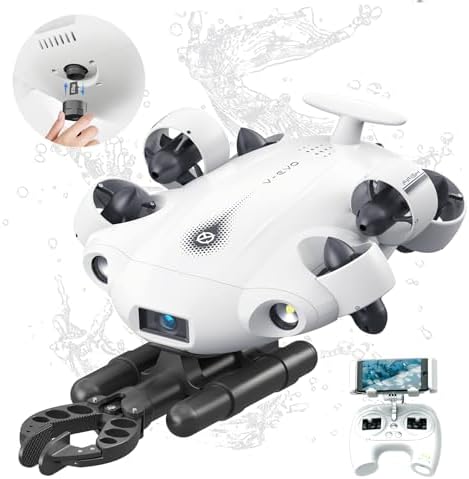
QYSEA Fifish V-EVO: Best Video, and It Can Grab Things Too
No sonar here, so it’s not competing with the PowerRay or the F1 Pro on fish-finding. What it does have is a sharp 4K/60fps camera, a 166-degree field of view, 5,000 lumens of light, and AI Vision Lock. That last part keeps the camera tracking a subject, a fish, a diver, a piece of structure, without you fighting the controls constantly. An optional two-finger robotic arm turns it into something that can retrieve a snagged lure or a lost anchor, not just watch.
Anglers who fish clear water and mostly want to see what’s holding near structure, rather than get a sonar readout, tend to like this one a lot. It’s also the pick if you’ve ever lost gear underwater and wished you had a way to go get it back.
Good for: clear-water anglers who want the sharpest video here, plus the option to retrieve gear.
Check the QYSEA Fifish V-EVO price on Amazon
QYSEA Fifish V6 Expert: Overkill for Most, Exactly Right for Some
This one’s a step past the V-EVO, in price and in capability. Same AI Vision Lock idea. But it pairs that with a built-in robotic arm. Up to six hours of working time. A depth rating of either 330 or 660 feet, depending on the package. It’s built more for serious inspection and salvage work than casual fishing, and the price reflects that.
Most anglers don’t need this. The handful who do, people scouting deep drop-offs, working commercial rigging, or running charter operations, will find it’s genuinely worth the jump.
Good for: serious operators who need real depth and arm-based retrieval, not weekend anglers.
Chasing Dory: Fine for Looking, Not a Fish Finder
Already covered this one in depth elsewhere on the site, so I’ll keep it short here. The Dory is cheap, easy, and fun, and it’ll show you structure and baitfish activity in shallow water near a dock or boat. It has no sonar and a 49-foot tether. If you want a low-stakes way to peek underwater without spending much, it’s a good little tool. If you searched “best underwater drone for fishing” hoping for something that finds fish for you, this isn’t it, whatever some other lists claim.
Check the Chasing Dory price on Amazon
Side-by-Side: What Each One Actually Gives You
Prices as of August 2, 2026. Amazon listings shift often, so treat these as ballpark and verify live.
| Drone | Roughly | Sonar | Bait drop | Depth | Video | Arm option |
|---|---|---|---|---|---|---|
| PowerVision PowerRay Wizard | $1,500–$1,900 | Yes, ~230 ft | Yes | ~98 ft | 4K | No |
| Chasing F1 Pro | ~$799 | No, camera-based detection | No | Shallow/mid | Standard | No |
| QYSEA Fifish V-EVO | ~$1,300–$1,500 | No | No | 330 ft | 4K/60fps | Optional |
| QYSEA Fifish V6 Expert | ~$2,200–$2,900 | No | No | 330–660 ft | 4K, 240fps slow-mo | Yes |
| Chasing Dory | $429–$499 | No | No | 49 ft | 1080p | No |
Notice something: only one drone here has sonar. Everything else is a video tool with varying degrees of polish. That’s not a knock on them; it’s just the honest state of the market right now. If sonar-based fish-finding is non-negotiable for you, your real choice is between the Wizard and waiting for the next thing to come along.
Wait, Are There Drones That Fly AND Go Underwater?
Short answer: not really, not as a mainstream consumer product. It’s a fair question, and it comes up a lot. But nobody’s shipping a drone that reliably flies through the air, dives, does useful underwater work, and flies home again. A few research and military prototypes have chased that idea. It’s a genuinely hard engineering problem. Sealing a flying airframe against water pressure while keeping it light enough to fly is not a small ask. For now, if you want aerial bait delivery, buy an aerial fishing drone like the SwellPro FD3. If you want to see underwater, buy an underwater drone. Nothing on the market does both jobs well in one body yet.
Murky Water: Where Sonar Actually Wins
This is worth calling out on its own, because it’s the situation where the gap between a camera-only drone and a sonar drone gets embarrassing. Stained rivers, tannic lakes, anything stirred up after rain, a camera might get you two or three feet of visibility before everything turns to soup. Sonar doesn’t care. It reads depth, structure, and fish regardless of what the water looks like. If you fish murky water regularly, camera-only drones are close to useless for finding fish, even good ones like the V-EVO. That’s not a minor asterisk, it’s the difference between a tool that works for your water and one that doesn’t.
Does Any of This Need a License?
For the drone itself, no. These are tethered, not flying, so FAA registration doesn’t apply. Your regular fishing license still applies exactly as it always did. One thing worth double-checking: a handful of states and specific tournaments restrict “electronic fish attraction” devices. Sonar-based scouting can fall under that umbrella, depending on how a local rule is worded. Worth a quick check if you fish competitively or somewhere with unusually strict regulations. Nobody’s going to stop you from using one on a random Tuesday at the lake.
Is It Illegal to Fly (or Float) One of These Over Someone’s Property?
This one comes up in searches around drones generally, so it’s worth a quick answer here even though these are underwater, not aerial. Since these don’t fly, airspace-over-property questions mostly don’t apply to them the way they would to a quadcopter. What can still matter: don’t run a tethered drone off a dock or shoreline that isn’t yours, or isn’t public, without permission. Be mindful of local rules around underwater filming near private docks or swimming areas. Common sense mostly covers it.
Saltwater, Battery Life, and the Boring Stuff That Actually Matters
Every drone here is rated for saltwater use, but rinse it with fresh water after every trip anyway. Salt eats seals and connectors slowly, and skipping the rinse is the single most common way people shorten the life of any of these. On battery: the Dory gets you about an hour, the PowerRay and QYSEA drones run closer to four. An hour sounds fine until you’re mid-scout and the battery dies before you’ve found anything. Buy a spare if you can.
Warranty and Support: The Part Buyers Skip
Autel backs its EVO line with a 1-year limited warranty. Support quality gets consistently good marks from owners, for firmware updates and part replacement, better than the smaller no-name brands here. QYSEA’s warranty terms run similarly, though its support network is thinner outside major markets, worth checking if you’re outside the US or Europe. Whichever you buy, confirm you’re ordering through the brand’s own Amazon storefront, or a listed authorized dealer, not a random third-party seller. Warranty coverage depends entirely on that.
Which One Should You Actually Buy?
If you want this decided for you: buy based on whether you need to find fish or just see the water. Don’t buy based on which one has the nicest camera in a marketing photo.
Need real fish-finding and don’t mind the price: PowerVision PowerRay Wizard. Want fish-finding on a tighter budget: Chasing F1 Pro. Want the sharpest video and a robotic arm for retrieving gear: QYSEA Fifish V-EVO. Doing serious depth or salvage work: the V6 Expert. Just want a cheap, fun way to peek under the dock: Chasing Dory.
Don’t buy the prettiest one. Buy the one that does the job you actually need done.
| Ready to buy? | Link |
|---|---|
| Best for finding fish | PowerRay Wizard on Amazon |
| Cheapest dedicated fish finder | Chasing F1 Pro on Amazon |
| Best video + optional arm | QYSEA Fifish V-EVO on Amazon |
| Cheapest way to just look | Chasing Dory on Amazon |
Where This Comes From
Haven’t wet-tested every one of these ourselves, so we won’t claim we did. Manufacturer specs gave us the hard numbers. Independent reviews from outlets that actually run these in the water gave us the real-world picture. Owner feedback filled in the rest: sonar accuracy, seal reliability, the stuff that only shows up after weeks of use. We ranked fish-finding ability first and video quality second, the opposite of what most “best of” lists do. If you fish with any of these regularly, tell us how the sonar performs on your water. That’s the one test no desk research can fake.
FAQs
What’s the best underwater drone for fishing?
Depends what you actually need it to do. If you want real fish-finding, the PowerVision PowerRay Wizard (sonar plus bait drop) or the cheaper Chasing F1 Pro are the honest picks. If you mostly want sharp video and don’t care about sonar, QYSEA’s Fifish V-EVO is the better camera. A lot of “best of” lists skip this distinction entirely and just rank by camera quality, which isn’t the same question.
Are underwater drones any good for fishing, or is it a gimmick?
They’re genuinely useful, with a caveat: only the sonar-equipped ones actually help you find fish in poor visibility or murky water. A camera-only drone still helps by showing structure and baitfish activity in clear, shallow water, but it’s not doing anything a good pair of polarized sunglasses and a slow drift wouldn’t eventually show you. Sonar is where the real advantage lives.
What’s the difference between an underwater drone and a fishing drone?
An underwater drone is tethered and goes down into the water to show you what’s there. A fishing drone, like the SwellPro FD3, flies over the water and drops your bait or line far offshore, then returns. They solve completely different problems and people mix them up in search results constantly.
Are there drones that can fly and go underwater?
Not really, not as anything you can buy and rely on. A few prototypes have tried it, and it’s a genuinely hard engineering problem, sealing something for underwater pressure while keeping it light enough to fly isn’t easy to pull off well. Right now, buy an aerial drone for flying, an underwater one for diving. Nothing mainstream does both.
Who makes the best underwater drone overall?
PowerVision leads on fish-finding sonar. QYSEA (the Fifish line) leads on camera quality, maneuverability, and modular tools like robotic arms. Chasing sits in the middle, strong at the budget end (Dory, F1 Pro) and competitive at the mid-tier (Gladius Mini S). None of the three “wins” outright; it depends which feature you actually care about.
Do underwater fishing drones work in murky water?
Only the sonar-equipped ones. A camera can lose almost all usefulness in stirred-up or tannic water, sometimes down to a couple of feet of visibility. Sonar reads through that regardless, which is exactly why PowerVision’s PowerSeeker system matters so much if murky water is your normal fishing conditions.
Does the Chasing Dory have a fish finder?
No. It’s a 1080p camera on a 49-foot tether, no sonar, no bait drop. It’s a fine, cheap way to look at structure and shallow-water activity, but it doesn’t detect fish the way the PowerRay or F1 Pro do. Some other sites list it as a top fishing pick anyway; we think that’s misleading given what it actually does.
How deep can these drones actually go?
The Dory tops out at 49 feet. The PowerRay models reach about 98 feet. QYSEA’s V-EVO reaches 330 feet, and the V6 Expert goes to 330 or 660 feet depending on the package. Most freshwater and inshore fishing situations are covered well under 100 feet; the deeper ratings mostly matter for serious offshore or structure-heavy work.
Do I need an FAA license to use one of these?
No. These are tethered underwater vehicles, not flying drones, so FAA registration doesn’t apply. Your regular state fishing license still governs the actual fishing. A few tournaments and some state rules restrict electronic fish-attraction devices, so check if you compete or fish somewhere unusually strict.
Is it illegal for my neighbor to fly a drone over my property?
This question comes up around drones in general, and it’s worth noting it doesn’t really apply to underwater drones, which don’t fly. For actual flying drones, FAA airspace rules generally allow overflight, though some states add privacy protections around low-altitude surveillance. Since nothing here flies, it’s mostly a non-issue for this category.
What’s the best underwater camera for fishing if I don’t need sonar?
QYSEA’s Fifish V-EVO, by a clear margin. The 4K/60fps footage, wide field of view, and AI Vision Lock make it the sharpest, easiest-to-use camera in this lineup. It won’t tell you where fish are hiding the way sonar does, but if visual scouting in clear water is all you want, it’s the best camera here.
Can these drones grab or retrieve things underwater?
The QYSEA Fifish V-EVO and V6 Expert both support an optional robotic arm attachment, useful for retrieving a snagged lure, a dropped tool, or a lost anchor. None of the Chasing or PowerVision drones in this guide have that option built in or available as an add-on.
Are there military-grade underwater drones for fishing?
Not really, and be skeptical of anything marketed that way for a consumer fishing use case. “Military-grade” in ROV marketing usually just means a more rugged commercial or industrial-tier product (something like QYSEA’s professional Fifish line), not an actual defense-spec device sold to the public. For fishing, you don’t need or want that tier; it’s built for inspection and salvage work, not scouting a lake.
How long do the batteries last on these?
The Dory gets about an hour. The PowerRay models and QYSEA drones run closer to four hours. An hour goes fast once you’re actually scouting instead of just testing the thing in your driveway, so if you’re buying a shorter-battery model, budget for a spare.
Can I use an underwater drone for ice fishing?
Yes, and it’s one of the more practical uses for these. Cut or use an existing hole, lower the drone through it on its tether, and you get a live look at structure and fish activity under the ice before you drill a dozen more holes hoping to get lucky. The Chasing Dory and F1 Pro both work fine for this in shallower lakes; just keep the drone and buoy from freezing to the ice if you’re out there a while.